What is a bulk email validation?
A bulk email validation runs a list of addresses through static checks that do not contact the destination mail server: RFC 5321 envelope syntax, DNS lookups, disposable matching, role patterns, gibberish scoring, and typo correction. It is the first of two layers in our bulk email verification service, catching 10 to 15 percent of bad addresses on typical lists (up to 20 percent on older, stale lists) before the SMTP verifier layer runs.
What is the difference between validation and verification?
Validation is the static layer above. Verification is the live SMTP handshake that confirms the recipient mailbox exists via an RCPT TO probe. Validation is cheap and deterministic. Verification is slower and authoritative on mailbox existence. Both layers together give 99.7 percent accuracy. See the bulk email verification for the SMTP half.
How many validation checks run on each address?
Sixteen. They group into three layers: syntax (RFC 5321 envelope, length limits, plus-addressing per RFC 5233), DNS (MX, A, AAAA, RFC 2606 and 6761 reserved TLDs, live IANA feed, RFC 1035 label rules), and intelligence plus cross-reference (disposable database, role patterns, free email provider detection, gibberish, Levenshtein typo correction, blacklist).
What is the best bulk email validation?
The best bulk email validation runs the full pipeline on every address rather than any one check in isolation: RFC 5321 envelope syntax, DNS with MX and A or AAAA fallback, reserved TLD rules per RFC 2606 and RFC 6761, disposable and role patterns, gibberish entropy scoring, Levenshtein typo correction, and provider-specific canonicalization for dedup. Static validation alone is not authoritative on mailbox existence, so a serious tool also pairs validation with live SMTP verification. Bulk Email Checker runs all sixteen static checks plus the SMTP verifier layer in one pipeline at 99.7 percent accuracy.
Is the max address length 254 or 320 octets?
254. The 320-octet figure most blog posts cite is a miscalculation. RFC 5321 §4.5.3.1.3 caps the envelope path at 254 octets because the angle brackets in the RCPT TO command consume part of the SMTP line length. We enforce 254.
How accurate is bulk email validation?
Validation alone catches 10 to 15 percent of bad addresses on typical lists, and up to 20 percent on older, stale lists. Accuracy at the validation layer is deterministic because the checks are either right or wrong against the RFC (a malformed address, a nonexistent TLD, a reserved string, a disposable domain). Validation is not authoritative on mailbox existence, which is what the SMTP verifier layer answers via RCPT TO. Both layers together run at 99.7 percent accuracy across the full pipeline.
What counts as a reserved TLD?
RFC 2606 reserves .test, .example, .invalid, and .localhost. RFC 6761 adds .onion and .local. ICANN reserved .internal in 2024. IANA policy forbids single-character TLDs. All are rejected without a DNS query.
How does typo correction actually work?
Levenshtein edit distance against hundreds of known provider domains, weighted by keyboard adjacency (gnail is closer to gmail than to kmail because g is next to n on a QWERTY layout). TLD swaps like .con→.com are a separate rule. Suggestions return in emailSuggested.
How do I validate an email list in bulk?
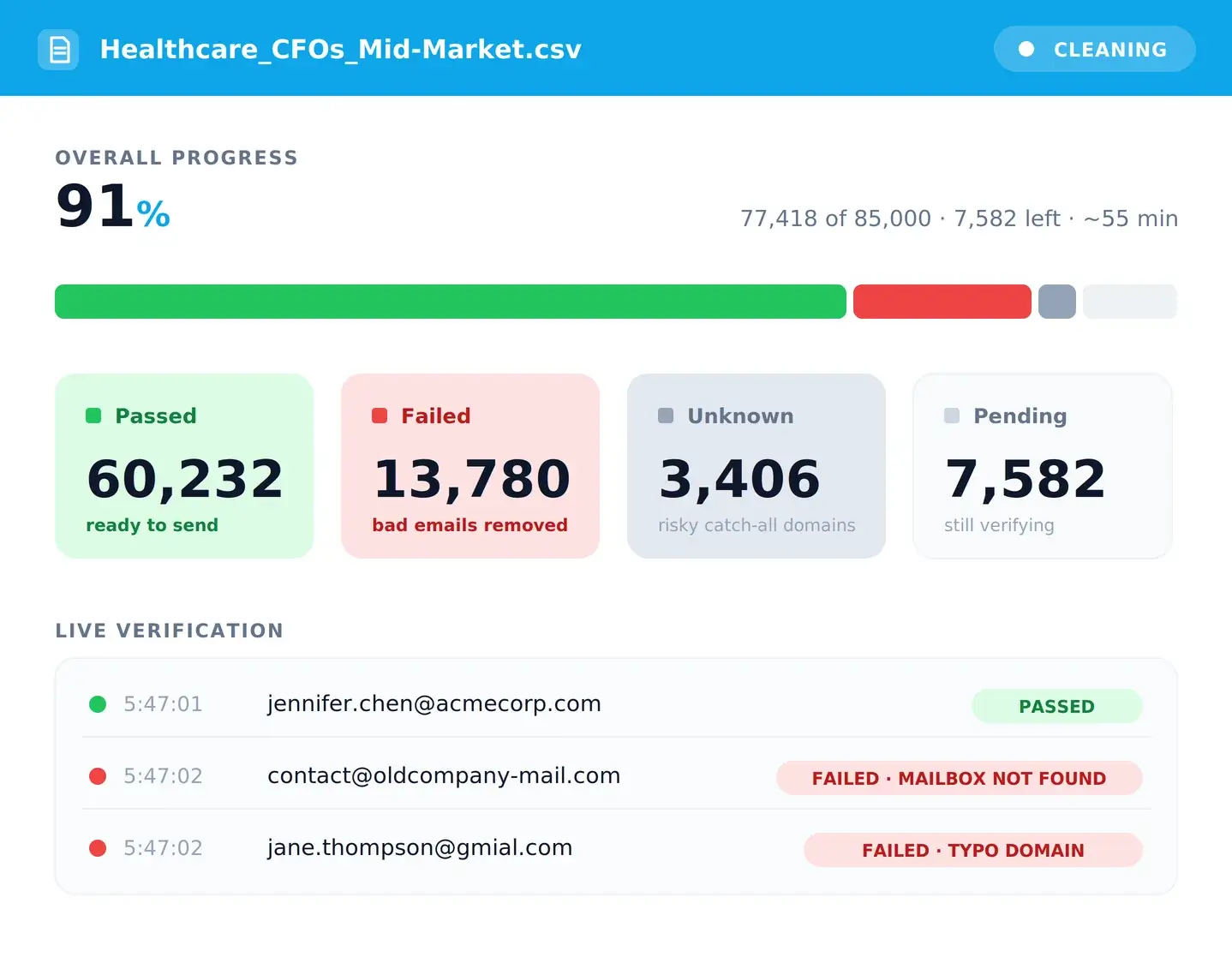
Upload the list as a CSV or TXT file. The validator runs its static checks on every address (RFC 5321 syntax, DNS lookups, disposable database, role patterns, typo correction, gibberish scoring), then the SMTP verifier layer probes every address that survived. Download the enriched list with pass or fail status, intelligence flags, suggested corrections, canonical form for dedup, and all original columns preserved byte-for-byte. Full walkthrough in the How It Works section above.
Is there a free bulk email validation?
Free validators typically stop at syntax (the @ check) or a DNS ping, without disposable matching, role patterns, typo correction, or canonical dedup. A real bulk email validation needs every layer on every address. Bulk Email Checker is pay-as-you-go starting at $2.95 for 1,000 validations, with no subscription, no monthly fee, and credits that never expire. The validator layer itself never consumes a credit. Credits are only spent when the SMTP verifier layer runs on what survives validation.
Is the disposable domain list updated?
Continuously. The dataset tracks over 272,174 domains and grows every day as new burner services surface. Historical entries remain so archived signups still resolve correctly.
What file formats does the validator accept?
CSV and TXT files. Excel files should be exported as CSV from Excel or Google Sheets before upload. Every original column is preserved byte-for-byte in the output.
How much does validation cost?
Pay-as-you-go starts at $2.95 for 1,000 validations. Volume tiers bring per-address cost down to $0.000132 at 25M. Credits never expire. Unknown results (DNS resolver failures, transient errors) consume zero credits.
Is bulk email validation GDPR compliant?
Yes. GDPR, CCPA, SOC 2 Type II, ISO 27001, and HIPAA ready. TLS 1.3 in transit, AES-256 at rest, per-tenant isolated containers, configurable retention, and a signed DPA ready for enterprise.
Can I use validation at signup time, not just on a list?
Yes. The same 16 checks are exposed through the Real-Time API with sub-second response times. Ideal for signup forms, checkout pages, and lead capture.
How often should I validate a list?
Every quarter at minimum. Lists decay at 2 to 3 percent per month. Always validate before a major campaign and route new leads through the Real-Time API at signup so no bad address ever enters the database.